How the “Margin of Safety” Concept Has Made Warren Buffett Billions
Joe Franklin explains why value investors look beyond volatility, how price and intrinsic value interact, and why the best opportunities often arrive when the crowd is most uncomfortable.
Are You Prepared to Lose Half?
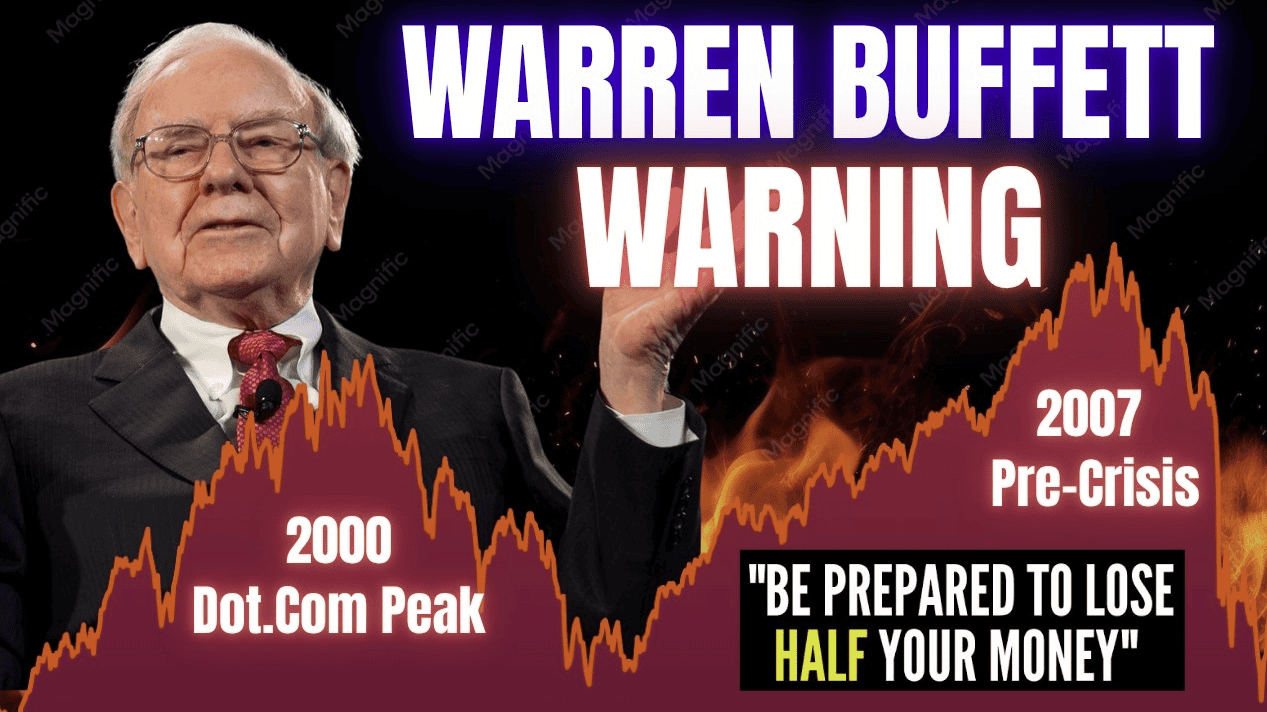
Warren Buffett has offered investors a blunt warning: “Be prepared to lose half of your money.” In other words, if a 50% decline would force you to abandon an investment, you may not be prepared to own it in the first place.
That can sound surprising coming from one of history’s most successful investors. Berkshire Hathaway itself has fallen by more than 50% several times over the past few decades. Buffett has not avoided every decline. Instead, he has built cash while prices were high, waited for better opportunities, and then moved aggressively when quality assets became available at prices he considered attractive.
At the time discussed in the video, Buffett was sitting on more than $400 billion in short-term Treasuries and cash equivalents because he did not see enough investments that appeared meaningfully mispriced. That patience is part of the strategy. Sometimes the right move is to do very little. At other times, when markets offer a genuine bargain, the right move may be to become quite active.
Two Very Different Definitions of Risk
Before deciding whether an investment is risky, we have to decide what risk means. That is where two major schools of thought begin to separate.
The margin-of-safety approach, first made famous by Benjamin Graham and later embodied by Buffett, Charlie Munger, Seth Klarman, Sir John Templeton and Peter Lynch, focuses on the relationship between price and value. Under this philosophy, risk increases when investors pay too much and decreases when they can buy a strong asset for substantially less than it is worth.
Modern portfolio theory approaches the subject differently. It often defines risk through volatility, meaning how much an investment’s price moves up and down over time. A security with larger price swings can therefore appear riskier, even if the decline has made it much cheaper relative to its underlying value.
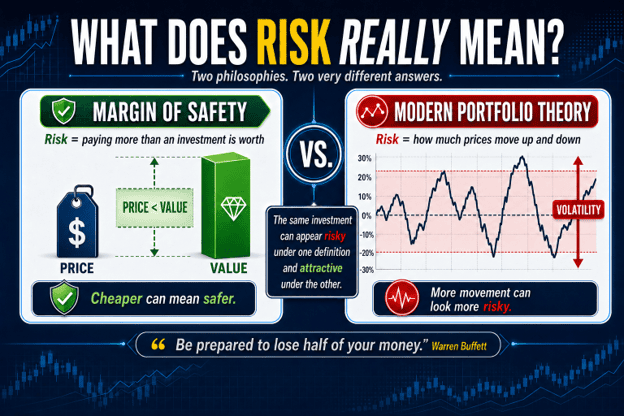
Two definitions of investment risk: price relative to value versus price volatility.
This difference is not academic. It changes how investors respond to falling markets. One investor sees a price decline and concludes that an asset has become more dangerous. Another sees the same decline and asks whether the underlying value has changed. If the value remains intact, the lower price may create a better opportunity and a wider cushion against loss.
Markets Are Not Always Efficient
The theory of efficient markets assumes that available information is quickly reflected in prices. Joe’s question is simple: if markets are always efficient, how do we explain the extremes?
How did the price of oil go negative in 2020 when storage capacity disappeared and traders were effectively paying others not to send them oil? How did stocks become so expensive in 2000, only to become dramatically cheaper by 2002? How did investors eagerly buy mortgage-related assets in 2007 and then rush to unload them only months later?
The answer, in Joe’s view, is that markets are often mispriced. Crowds can become the most wrong at the extremes. That mispricing is not merely a flaw in the system. It is also what creates the possibility of above-average long-term returns for investors who can remain patient, estimate value and act when price moves far enough away from that value.
Modern portfolio theory may help create a more emotionally comfortable ride by trying to minimize the ups and downs. Charlie Munger called much of what is taught in modern corporate finance courses ‘twaddle,’ while Buffett argued that it had little utility for the way he invests. Joe’s point is not that emotional comfort has no value. It is that investors who focus primarily on comfort may miss the periods when the greatest opportunities are being created.
The $900 Bond and the $500 Bond
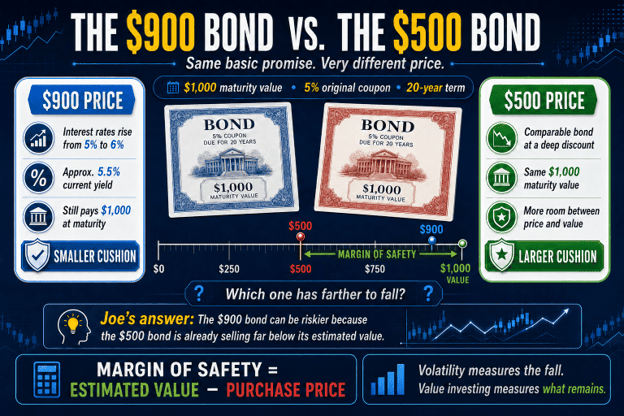
Joe’s bond example: the lower-priced bond can offer the larger margin of safety.
A bond makes the difference between volatility and margin of safety easier to see. Imagine a newly issued $1,000 bond paying 5% interest and maturing at $1,000 in 20 years. If prevailing interest rates rise from 5% to 6%, Joe estimates that the bond’s market price might fall by roughly 10%, bringing it to about $900. The bond would then provide an approximate current yield of 5.5%, while still paying $1,000 at maturity, assuming the issuer remains able to meet its obligations.
Did the decline from $1,000 to $900 make the bond more dangerous? If its credit quality has not changed, the likelihood of receiving the promised interest and maturity value has not necessarily changed either. The market price moved, but the basic payment promise remained the same.
Now compare that $900 bond with a very similar bond selling for $500. Modern portfolio theory may label the $500 bond as riskier because it has experienced a much larger decline. A value investor may reach the opposite conclusion. If the comparable bond is worth roughly $900 and can be purchased for $500, the buyer has a much wider difference between price and estimated value. That difference is the margin of safety.
Think about it the way you would think about a sale at a store. If the same item is available for 50% off, you are taking less price risk than the person paying full price. The discount does not guarantee a successful outcome, and the estimate of value must still be sound. However, a lower purchase price gives the buyer more room for error.
Value Investors Look for Winning Tickets in the Trash
Buffett’s early experience at the racetrack offers a memorable picture of this mindset. As a teenager, he would search through discarded betting slips after the races, looking for winning tickets that other people had accidentally thrown away. When he found one, he could cash it in even though it had cost him nothing.
That is how value investors want to approach markets. They are looking for diamonds in the rough, assets that the crowd has discarded or ignored even though their underlying worth remains. They buy cheaply, wait for price and value to reconnect, and, when they own a high-quality business, may be able to hold it for a very long time.
Quality matters because even a careful investor can make an imperfect analysis. A durable company with strong economics can sometimes overcome a purchase price that was not quite as low as expected. Quality can also give the investor the confidence and time required to hold through temporary market pressure.
How Do We Estimate Intrinsic Value?
The margin of safety only means something if the investor has a reasonable estimate of what the investment is worth. Value investors use several methods, and no single method is right for every company.
Liquidation value
One method is to add up a company’s assets and subtract its liabilities. If the individual pieces could be sold for more than the current price of the entire company, the investor may have found a compelling value. This approach can be especially useful when tangible assets are an important part of the business.
Relative value
Another method compares the company’s current valuation with its own history. Investors may examine price-to-earnings or price-to-revenue ratios and ask whether the business is trading much more cheaply than it has in the past. A low relative valuation does not automatically make a company attractive, but it can identify situations that deserve a closer look.
Discounted cash flow
A third method values a company much like a bond by estimating the cash it can produce in the future and discounting that cash back to the present. Buffett often focuses on what he calls owner’s earnings, the cash the business generates after the capital expenditures required to maintain its operations. Joe describes Buffett’s preferred framework as a two-stage cash flow model that recognizes different periods of growth.
The Skyscraper Test
Joe’s skyscraper analogy brings quality and valuation together. First, ask how well the skyscraper is built. Was it engineered properly? Does it use strong materials? Is it durable, or is it old and deteriorating? That is the quality question.
Next, ask which floor you are entering. If you step onto the elevator on the 75th floor of a 100-story building, only 25 floors remain above you, while there is a long distance below. If you enter on the second floor, 98 floors remain above and there is very little distance to the bottom.
Momentum investors often prefer an elevator that is already moving up. That movement can continue, particularly until prices reach an extreme. Value investors place more emphasis on the entry floor. Even if the elevator is moving down when they enter near the bottom, there is more room to rise than to fall over a longer period.
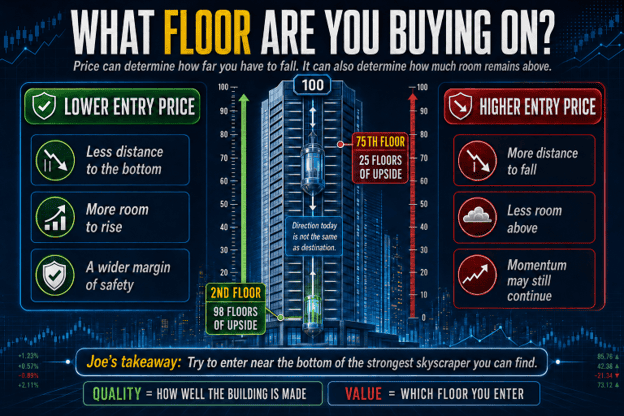
The skyscraper test: quality is the building, while value is the floor where you enter.
The goal is not simply to buy the lowest floor in any building. A poorly constructed skyscraper can still be dangerous. The goal is to enter near the bottom of the strongest skyscraper available, meaning a high-quality investment purchased at a low price relative to its estimated worth.
Mr. Market Is There to Serve You
Benjamin Graham introduced the character of Mr. Market in The Intelligent Investor, and Buffett has returned to the story repeatedly. Imagine that Mr. Market is your business partner. Every day, he offers either to buy your share of the business or to sell you his share. His mood changes constantly.
Some days he is euphoric and offers an exorbitant price for your half. You do not have to accept, but you may decide the price is too attractive to ignore. On other days he is deeply pessimistic and offers to sell his half at an unusually low price. Again, you do not have to act. You can take advantage of the offer only when it serves you.
This is the value investor’s relationship with market volatility. Price movement is not a command. It is an offer. The challenge is to keep your own temperament steady enough to recognize when Mr. Market has moved to an extreme.
What the Best Investment Managers Have in Common
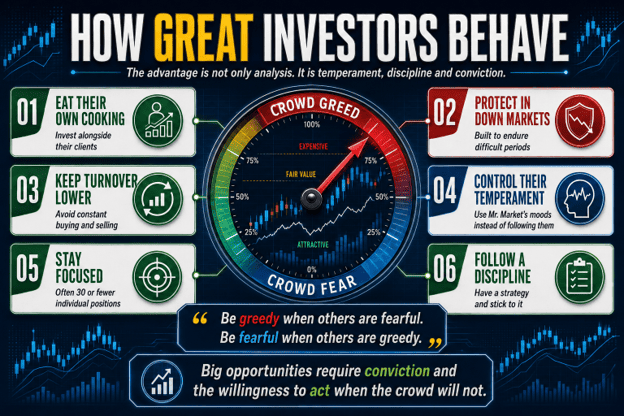
Looking across managers such as Buffett, Munger, Templeton and Lynch, Joe identifies a set of recurring characteristics. The best investors tend to eat their own cooking by investing alongside their clients. They have demonstrated an ability to protect capital in down markets, keep turnover relatively low and resist buying and selling simply because the crowd has changed direction.
They also have the right temperament. They can become more interested when Mr. Market is fearful and more cautious when he is exuberant. They often hold focused portfolios of 30 or fewer individual positions, putting more capital into their best ideas rather than spreading every dollar thinly across a large number of mediocre opportunities.
Most importantly, they are disciplined. They have a strategy and stick with it. A great opportunity handled timidly may not meaningfully affect the outcome. As Munger observed in the video, big opportunities in life have to be seized. Acting on too small a scale can be nearly as costly as failing to act at all.
The Real Risk May Be Paying Too Much
A falling price can feel frightening, and sometimes that fear is justified. Businesses can deteriorate. Credit quality can weaken. Estimates of intrinsic value can be wrong. A low price alone does not make an investment safe.
But Joe’s larger point is that volatility and risk are not always the same thing. If price falls while underlying value remains strong, the investment may be becoming less risky under a margin-of-safety framework. The buyer is paying less for the same future cash flows, assets or maturity value.
That is why disciplined value investors try to be greedy when others are fearful and fearful when others are greedy. They do not follow the crowd simply because it is moving. They compare price with value, insist on quality, wait patiently and act with conviction when the gap becomes wide enough.
Build a Strategy You Can Hold Through the Cycle
The most sophisticated valuation model is not useful if an investor cannot stay disciplined when markets become uncomfortable. A successful strategy must account for financial goals, time horizon, income needs, tax situation, risk capacity and the investor’s ability to remain patient during periods of volatility.
At Franklin Wealth Management, we believe investment decisions should be coordinated with the rest of your financial life. If you want to review whether your portfolio reflects your goals, your need for income and your ability to stay invested through changing markets, our team would be glad to help you build a plan designed for the full journey.
For more on this topic, watch our YouTube video here: https://youtu.be/MW3j1TAL-OM