
The American Wealth Map Is Changing
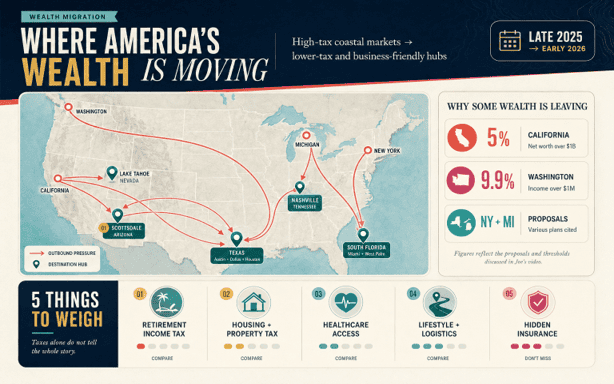
In late 2025 and early 2026, we saw a significant migration of high-net-worth individuals away from several expensive, high-tax states. Proposed wealth and income taxes were a major part of that conversation—including a proposed 5% tax on net worth above $1 billion in California, a proposed 9.9% tax on income above $1 million in Washington state, and other ideas under discussion in New York and Michigan.
California remains the highest-tax state in the country in the comparison I discussed, and taxes are not the only issue. Concerns about crime, homelessness, housing costs and quality of life have also caused some residents to look elsewhere. The broad direction has been away from costly states in the Northeast and on the West Coast and toward states such as Texas, Arizona, Nevada, Florida and Tennessee.
Taxes Start the Conversation, but They Do Not Finish It
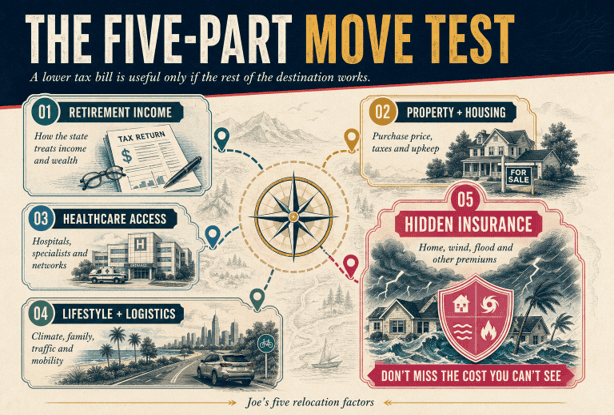
When people consider moving to another state, five issues tend to shape the decision. The first is how retirement income and wealth are taxed. The second is property tax and the cost of housing. The third is access to healthcare. The fourth is lifestyle and logistics—climate, traffic, airports, family and the ability to get around. The fifth, and one of the biggest, is the hidden cost of insurance.
A state with no individual income tax can still be expensive if home prices, property taxes or insurance premiums are high. A beautiful destination can lose some of its appeal if residents cannot reach the specialists they need, if traffic makes daily life difficult, or if children and grandchildren cannot build a life nearby. The move has to work as a financial decision and as a life decision.
Austin Helped Signal the Shift
Austin, Texas, remains one of the most popular destinations in the migration story. Matthew McConaughey made his move to Austin in 2014. Joe Rogan followed in 2020, and Elon Musk in 2021. More recently, I highlighted venture capitalist David Sacks establishing residency there toward the end of 2025 and Uber founder Travis Kalanick making the move in early 2026.
Those individual moves fit a larger pattern. Goldman Sachs and JPMorgan have moved people to Texas, while Oppenheimer personnel relocated there after the firm became part of Invesco. Chevron also moved its headquarters from California back to Texas. Texas combines no state individual income tax with business opportunity, large metropolitan areas and access to major healthcare systems. That does not make every Texas city inexpensive, but it helps explain why the state continues to attract both companies and high-net-worth households.
Miami and West Palm Beach: Florida’s Financial Corridor
Miami has become another major hot spot—what some people now call the technology capital of the South. Florida remains one of the most popular destinations for wealthy New Yorkers, even as higher housing and insurance costs have caused other residents to leave the state.
The concentration of financial firms in West Palm Beach has earned the area the nickname “Wall Street South.” In the video, I pointed to Jeff Bezos, Mark Zuckerberg, Google co-founder Larry Page and former Starbucks CEO Howard Schultz among the high-profile names establishing or showing Florida residency. I also discussed Oracle founder Larry Ellison’s move into West Palm Beach and his purchase of a major resort complex there.
The business footprint is just as important as the celebrity names. Wells Fargo, Citadel, BlackRock, Elliott Management and other firms have established or expanded their presence in the West Palm Beach corridor. Farther west, ARK Invest founder Cathie Wood’s move to the Tampa area shows that Florida’s financial migration is not limited to Miami and Palm Beach.
Nashville Is Becoming More Than an Entertainment Center
Nashville has long attracted musicians, entertainers and people who want a growing Southern city with no state individual income tax. Now the corporate story is becoming just as important. Starbucks has been creating a second headquarters presence in Nashville, bringing employees from Seattle. AllianceBernstein moved its headquarters from New York to Nashville several years ago.
Oracle has also announced plans to shift its headquarters from Austin to Nashville to be closer to the healthcare industry, and In-N-Out Burger owner Lynsi Snyder has moved both her home and the company’s eastern operations toward Tennessee. These moves reflect favorable business conditions, lower taxes and, in the opinion of the people making them, a better place to live and work going forward.
Lake Tahoe, Nevada and the Western Alternative
Not everyone leaving California wants to leave the West. Google co-founder Sergey Brin recently purchased what was described in the video as the largest home in the Lake Tahoe area, and a number of people connected to technology companies have also looked to the Nevada side of Tahoe. Nevada offers proximity to California without the same state individual income-tax structure, making it a natural alternative for people who want the mountains, climate and access to the Bay Area.
The New No. 1 Is Scottsdale, Arizona
None of those cities, however, held the top position in the ranking discussed in the video. It was not Aspen, where many wealthy families own second homes. The most popular place for millionaires and centimillionaires to establish a primary residence was the Scottsdale area of Arizona.
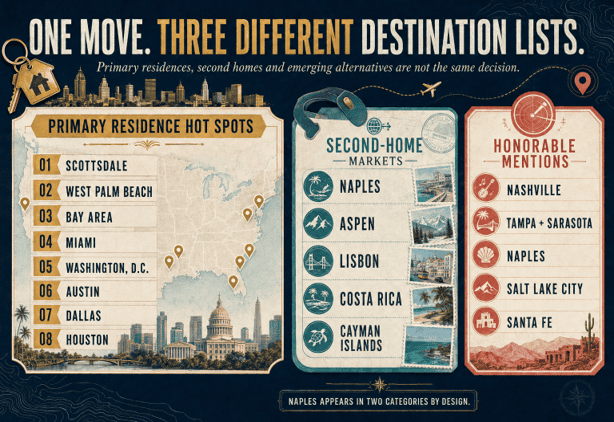
Scottsdale was followed by West Palm Beach and the Bay Area. The Bay Area remains unusual because many people are not moving there to retire; they are becoming millionaires and centimillionaires there through technology, venture capital and business creation. Miami, Washington, D.C., and Austin also ranked prominently, followed by Dallas, with Houston appearing at the end of the top 20 list discussed in the video.

Primary Residences and Second Homes Tell Different Stories
The place someone chooses as a primary residence is not necessarily the place they choose for a second home. Scottsdale and West Palm Beach lead the primary-residence conversation, while Naples and Aspen remain favorites for seasonal living. Overseas, Lisbon, Portugal, destinations in Costa Rica and the Cayman Islands continue to attract second-home buyers.
Several cities made the honorable-mention list for primary residences: Nashville; Tampa and Sarasota; Naples; Salt Lake City; and Santa Fe. Santa Fe offers high elevation and a distinct climate without the severe cold found in some mountain destinations. Salt Lake City provides access to outdoor recreation and a lower-tax alternative for people leaving more expensive western markets.
Why Wealthy Households Are Making These Moves
The tax headline gets attention, but several motivations tend to overlap. Safety and security have become more important as people evaluate crime and whether they will feel comfortable in their community. Financial concerns include income taxes, property taxes, housing costs and the possibility of new wealth taxes. For retirees, established communities and access to activities and support matter as well.
Work and business opportunities remain central in Austin, Nashville, South Florida, Dallas and the Bay Area. Lifestyle factors—climate, seasons, cost of living and recreation—can determine whether someone stays after the initial move. Education becomes important even for older households because children and grandchildren may eventually move nearby. Healthcare is a major concern, and the destinations discussed in the video generally offer access to strong medical facilities.
That is why this is not simply a list of low-tax states. It is a list of places where wealthy households believe their money, businesses and families may have a better opportunity to thrive.
Should You Follow the Millionaires?
Where wealthy families are moving can reveal something about taxes, business conditions and future growth. It does not automatically identify the best place for your retirement. A billionaire choosing Scottsdale or West Palm Beach may be working with a very different housing, insurance and healthcare budget than the average retiree.
Before you move, compare the five factors using your own numbers:
- Estimate how the destination will tax your actual mix of wages, investment income, Social Security, pensions and retirement-account withdrawals.
- Compare home prices, property taxes, maintenance, HOA fees and the cost of making the home suitable as you age.
- Price homeowners, wind, flood, auto and umbrella coverage before assuming a no-income-tax state will cost less.
- Evaluate hospitals, specialists, insurance networks and the distance to family members who may eventually help provide support.
- Spend enough time in the area to understand traffic, weather, culture, airports and daily life—not only the vacation experience.
The best destination is the place where taxes, safety, healthcare, family, lifestyle and long-term affordability work together. If you have made a move recently—or you are considering one—we would like to hear where you chose and why. Those real experiences help all of us understand where people want to live going forward.
A Move Should Be Part of a Coordinated Plan
Changing residency can affect income taxes, estate planning, insurance, healthcare, property ownership and the way your portfolio supports your lifestyle. Before making the move, it can help to model those tradeoffs together rather than evaluating each one in isolation.
Considering a move in retirement?
Franklin Wealth Management can help you compare how the decision fits into your retirement-income, tax and estate plan.