

For millions of Americans, Social Security is not simply another line on a retirement-income worksheet. It is a critical part of their financial foundation.
That is why the growing conversation around Social Security reform deserves more than political sound bites. Proposals to strengthen the program may sound simple—raise the payroll tax, increase or eliminate the taxable earnings cap, reduce cost-of-living adjustments, raise the retirement age, or limit benefits for higher-income retirees—but every option comes with tradeoffs.
The real question is not whether Social Security needs attention. It does. The better question is: How can the program be strengthened without creating unintended consequences for retirees, workers, families, and business owners?
Why Social Security Faces a Funding Challenge
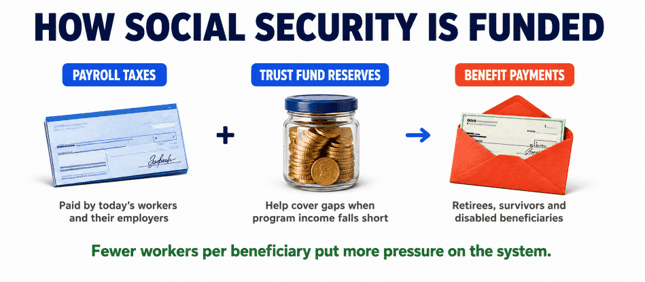
Social Security is funded primarily through payroll taxes paid by today’s workers and their employers. Those dollars are used to pay benefits to today’s retirees, survivors, and disabled beneficiaries. When payroll-tax income and other program revenue are not enough to cover scheduled benefits, Social Security draws from its trust fund reserves.
The strain on the system has been building for years. Americans are generally living longer, birth rates have declined, and the large baby-boom generation continues to move through retirement. As a result, fewer workers are supporting each beneficiary than in earlier decades.
According to the 2026 Social Security Trustees Report, the combined Old-Age, Survivors, and Disability Insurance trust fund reserves are projected to become depleted in 2034 if Congress makes no changes. Depletion does not mean Social Security disappears. Ongoing payroll-tax revenue would continue to fund a substantial portion of scheduled benefits. It does mean, however, that the system would be unable to pay all scheduled benefits under current law.
That distinction matters. Social Security is facing a serious financing shortfall, but fear is not a retirement strategy. Clear information and thoughtful preparation are far more useful.
The Most Discussed Reform Options
There is no single proposal guaranteed to become law. Lawmakers and policy analysts have considered many combinations of revenue increases and benefit changes. Some of the most frequently discussed options include:
1. Raising or eliminating the taxable earnings cap
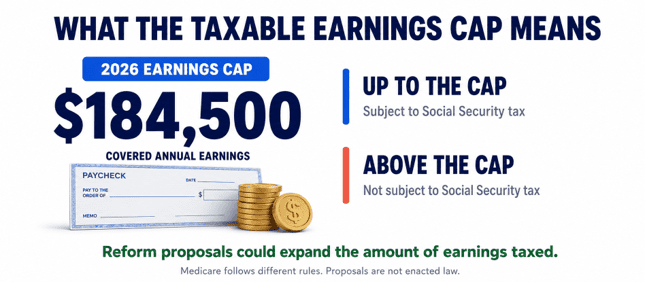
In 2026, Social Security payroll tax applies to covered earnings up to $184,500. Earnings above that amount are not subject to the Social Security portion of payroll tax, although Medicare taxes follow different rules.
Some proposals would apply Social Security tax again above a higher income threshold; others would eventually tax all covered earnings. Supporters argue that this could raise significant revenue and ask higher earners to contribute more. Critics point to the added cost for employers, employees, and self-employed individuals—and to the possibility that taxpayers could change how they work, structure compensation, hire, invest, or retire.
Another important question is whether earnings taxed above today’s cap would generate additional future benefits. The answer depends entirely on the design of the legislation. A reform that collects more tax while awarding full additional benefit credit has a different long-term financial effect than one that provides limited or no additional benefit credit.
2. Increasing the payroll-tax rate
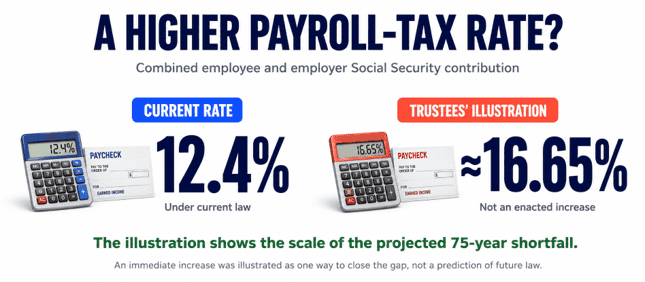
The current combined Social Security payroll-tax rate is 12.4%—generally divided equally between employee and employer, while self-employed individuals are responsible for both portions, subject to applicable deductions.
The Trustees Report illustrates the scale of the challenge: an immediate increase from 12.4% to approximately 16.65% was one example of a change that could close the projected 75-year shortfall on its own. Waiting until trust fund depletion would require a larger adjustment. This is not a prediction of what Congress will enact; it is a useful illustration of how the cost of delay can grow.
3. Changing benefits, retirement ages, or cost-of-living adjustments
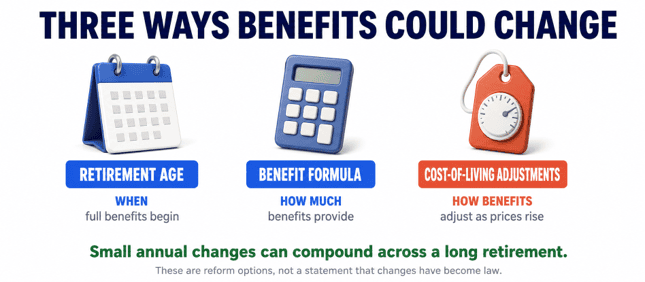
Other proposals focus on the benefit side of the equation. These may include gradually raising the full retirement age, modifying the benefit formula for higher earners, changing how annual cost-of-living adjustments are calculated, or increasing protections for lower-income beneficiaries.
Each approach affects people differently. A higher retirement age may be more manageable for someone in a less physically demanding career than for someone whose health or occupation makes working longer difficult. A smaller cost-of-living adjustment may look modest on paper but can compound over a 20- or 30-year retirement—especially when healthcare, housing, food, and other essential costs continue to rise.
Why Business Owners Should Pay Close Attention
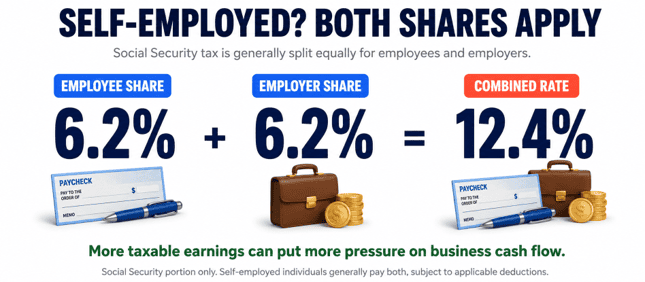
Proposals that raise or remove the taxable earnings cap could have an especially noticeable effect on business owners and self-employed professionals.
Employees typically see their portion of payroll tax withheld from a paycheck while an employer pays the matching portion. A self-employed person generally bears both sides. That makes any expansion of the Social Security tax base more visible—and potentially more consequential for cash flow, hiring, compensation, retirement-plan contributions, and decisions about when to retire.
Business structure and compensation strategy may also affect how different forms of income are taxed. These are complex areas, and the right choice should never be based on one tax in isolation. Any strategy should be evaluated with a qualified tax professional and financial advisor, with careful attention to reasonable-compensation rules, business needs, retirement goals, and current law.
Inflation May Be the Risk Retirees Feel Most

Taxes and benefit formulas receive much of the attention, but inflation can quietly do just as much damage to a retirement plan.
Even when a retiree’s income rises over time, it may not rise at the same pace as the costs that matter most to that household. A small difference in inflation, compounded across decades, can meaningfully reduce purchasing power. That is why retirement planning should not focus solely on reaching a target account balance. It should address the future cost of a desired lifestyle and build an income strategy designed to adapt.
For many families, that means considering:
- how and when to claim Social Security;
- which accounts to draw from first;
- how taxes may change throughout retirement;
- whether investments provide an appropriate balance of growth, income, and protection;
- how healthcare and long-term-care expenses could affect the plan; and
- how much flexibility is available if laws, markets, or personal circumstances change.
What You Can Do Now

You cannot control which reform Congress ultimately chooses. And if nothing gets done, Social Security earnings could be cut by 22%. What you can do, though, is control how prepared you are.
Start by reviewing your Social Security earnings record and current benefit estimate. Then model more than one scenario. What happens if you claim earlier or later? What if future benefits are lower than currently projected? What if inflation remains elevated? What if tax rates rise? For business owners, what if payroll costs increase?
Planning with a margin of safety is not pessimistic. It is wise stewardship.
At Franklin Wealth Management, we believe financial planning should be both technically sound and grounded in purpose. Wealth is not merely something to accumulate; it is something we are entrusted to manage responsibly—for our families, the people we serve, and purposes greater than ourselves.
Social Security was designed to provide a foundation, not to carry the full weight of retirement. The stronger your personal plan is, the less dependent your future becomes on any single government decision.
The Bottom Line

Social Security reform will likely require a combination of solutions. Protecting those in or near retirement, helping prevent senior poverty, preserving incentives to work and build businesses, and balancing new revenue with responsible spending are all worthy goals. The difficulty is achieving them together.
The longer meaningful reform is delayed, the more concentrated and painful the eventual changes may become. But individuals do not have to wait for Washington before strengthening their own plans.
Stay informed. Prepare for more than one outcome. Work with professionals who understand how taxes, investments, Social Security, estate planning, and retirement income fit together. Above all, approach the future with wisdom rather than fear.
Because good planning is not about predicting every change. It is about building the flexibility to meet change well.